Structural Drying and Dehumidification in Chatsworth, CA
Structural drying in Chatsworth, CA, 24/7. The drying team sets air movers and LGR dehumidifiers to the class of loss, logs readings every day and keeps the equipment running until framing, subfloor and concrete reach the dry goal.
(888) 578-6508Floor looks dry but feels damp? Phone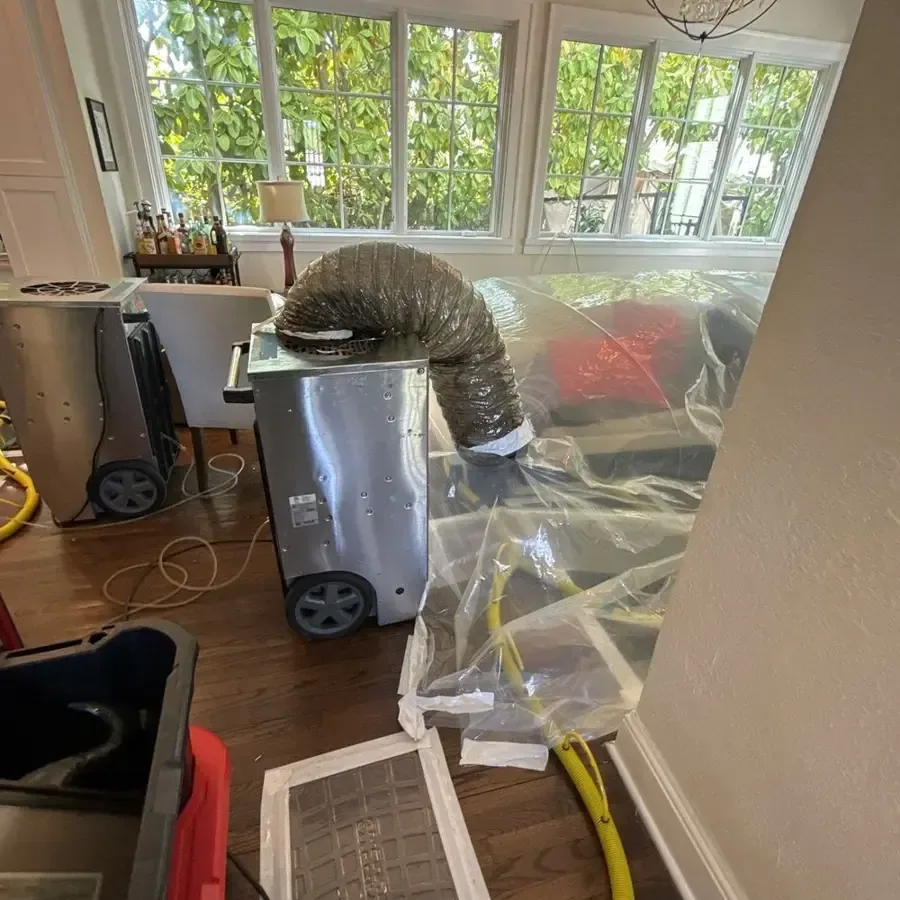
First steps for structural drying and dehumidification in Chatsworth
Leave the equipment running
Air movers and dehumidifiers work around the clock, and switching them off resets progress.
Keep doors and windows shut
The drying team sets the room up as a closed system.
Keep the thermostat steady
Warm, stable air speeds up evaporation.
Stay off wet carpet
Walk around the drying areas where possible.
How structural drying and dehumidification gets handled
Map and set goals
Readings in wet and dry areas set the drying goal for each material.
Size the equipment
Air movers and dehumidifiers match the class of loss and the room volume.
Log every day
Psychrometric readings show progress and guide changes to the setup.
Verify dry
Equipment comes out when the readings meet the goal.
What does structural drying and dehumidification cost in Chatsworth, CA?
Structural drying in Chatsworth, CA typically runs $1,200 to $12,000 or more as part of a water damage job. The class of loss, the square footage, dense materials like concrete and the number of drying days set the cost.
Ranges are typical, not a quote: the water category, the square footage, the material class and how fast drying started move the number most. Run the water damage cost calculator for a closer planning range.
Map, extract, dry, verify
- 1
Map
Pinless meters and a thermal camera show where the water went before anything is moved.
- 2
Extract
Truck-mounted units pull the free water first, because extraction removes far more than evaporation.
- 3
Dry
Air movers and LGR dehumidifiers run at the load each room needs, logged once a day.
- 4
Verify
The drying phase ends when materials read within 2 to 4 points of a dry reference.
Sizing structural drying to the class of loss
Structural drying is the part of a water loss nobody sees. The surface can look dry in a day while framing, subfloor and concrete still hold water, and that hidden moisture is what warps floors and swells cabinets later.
Class 1 to 4 describes how much water was absorbed and by what. The drying team sizes the air movers to the wet surfaces and the dehumidifiers to the room volume and the class. Desiccant units handle dense Class 4 materials such as a soaked slab or hardwood.
Dry summer air, damp winter air
Most of the year the air here is warm and dry, which helps evaporation. In a wet winter storm week the outside air is damp, so the job runs closed, with dehumidifiers doing more of the work. Daily psychrometric readings show whether the setup is pulling water out fast enough.
When drying is finished
- Readings are taken in the same spots every day
- A dry reference is read in an unaffected room
- Equipment leaves when materials sit within 2 to 4 points of it
- The final readings close out the claim file
See water extraction for the step that comes before drying.
Background from public agencies: EPA indoor air quality and Energy Saver from the Department of Energy.
Equipment stays until the readings say dry. The drying time estimator gives a planning range for the rooms involved.
Structural drying and dehumidification across Chatsworth and nearby
The local restoration pros cover ZIP 91311 and 91313, from the Stoney Point and Santa Susana Pass foothills and the horsekeeping streets to the Devonshire Street core, the Lassen and Plummer tracts, the Nordhoff business parks and the hillside homes along Valley Circle Boulevard.
Nearby coverage reaches Porter Ranch, Northridge, West Hills, Canoga Park, Winnetka, Chatsworth Lake Manor, Box Canyon, Calabasas.
Related water damage services in Chatsworth
Structural Drying and Dehumidification: questions and answers
How long does structural drying take?
Three to five days for most Class 1 and 2 losses, longer for hardwood, plaster and concrete. The drying time estimator gives a planning range.
Why can't the drying equipment be turned off at night?
Drying works by keeping evaporation and dehumidification steady. Switching off lets moisture settle back into materials and adds days.
What is a dry reference?
A reading taken on the same material in an unaffected part of the home. The goal is for wet materials to read within 2 to 4 points of it.
Is structural drying noisy?
Air movers and dehumidifiers make a steady sound. The drying team places them to cover the wet areas with as few units as the class of loss allows.
Does the drying record help the insurance claim?
Yes. Daily psychrometric logs and moisture readings show the work was needed and when it was done. Coverage depends on your policy, so check with your insurer. Dispatch runs 24/7.
Surface dry but walls still wet? Finish the drying.
Readings, not appearances, decide when a structure is dry. The drying team sets up day or night.