Slab Leak Water Damage in Calabasas, CA
Restoring floors and walls after a slab leak in Calabasas, CA, 24/7. Once a plumber has stopped the leak, the drying team maps the wet area, pulls up only flooring that tests wet, and dries concrete and lower walls to a dry reference reading.
(888) 578-6508Damp spot or warm floor? Phone the drying team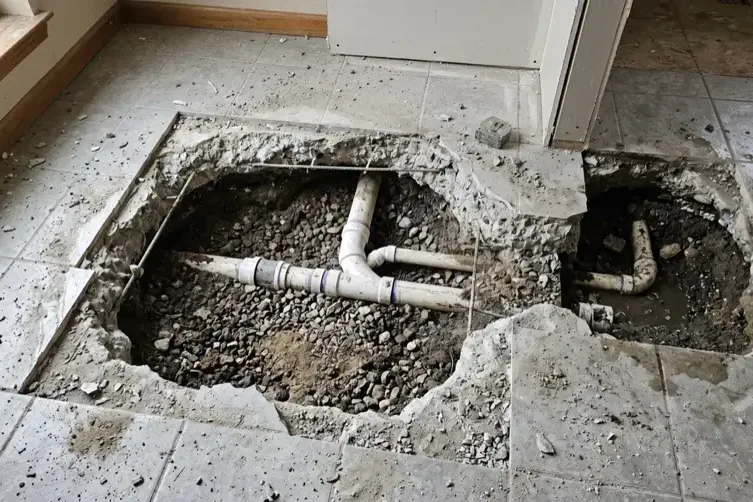
First steps for slab leak water damage in Calabasas
Watch the meter
Turn off every tap and appliance, then check the meter; if it still turns, water is escaping somewhere.
Turn off the supply
Close the main valve so the line under the floor stops feeding water into the slab.
Flag damp areas
Put painter's tape around warm or damp patches for the plumber and the drying tech.
Keep the bills
Bills from the district that jump without more use help date the start of the leak.
How slab leak water damage gets handled
Trace the moisture
A thermal camera and pin meters show how far water has spread from the leak under the floor.
Open the wet areas only
Flooring and baseboards that test wet are taken up, and dry sections stay in place.
Dry the concrete
Dehumidifiers and air movers work across the bare slab, and wet lower walls are opened.
Check, then rebuild
New flooring goes down only after the concrete matches its dry reference.
What does slab leak water damage cost in Calabasas, CA?
In Calabasas, CA, removal and drying after a slab leak usually costs $2,000 to $9,000, not counting the plumber's repair. Wet square footage, the kind of flooring and the length of time the leak ran decide the figure.
Ranges are typical, not a quote: the water category, the square footage, the material class and how fast drying started move the number most. Run the water damage cost calculator for a closer planning range.
Map, extract, dry, verify
- 1
Map
Pinless meters and a thermal camera show where the water went before anything is moved.
- 2
Extract
Truck-mounted units pull the free water first, because extraction removes far more than evaporation.
- 3
Dry
Air movers and LGR dehumidifiers run at the load each room needs, logged once a day.
- 4
Verify
The drying phase ends when materials read within 2 to 4 points of a dry reference.
Spotting a leak beneath the floor
A slab leak starts in a water line under the concrete floor, so the first signs show up on the surface: a damp patch, a floor that feels warm over a hot water line, or a bill from Las Virgenes Municipal Water District that climbs for no clear reason.
- Tile or wood that feels warm in one patch
- Carpet edges or trim damp with nothing leaking nearby
- A meter that keeps turning while every tap is closed
- A bill from the district that rises while use stays flat
Plumber first, then the drying team
Stopping the leak is the plumber's job, and many choose a new line through the walls or attic over cutting the slab. Everything the water already touched is the drying team's job: measuring the spread, taking up wet flooring and placing dehumidifiers on the concrete.
Why concrete dries slowly
A slab holds moisture deep inside and lets it go a little at a time. Desiccant or LGR units pull water from the air above the bare floor while air movers keep it moving, and readings are written down daily until the slab matches a dry spot in another room.
The drying time estimator shows typical ranges, and structural drying explains the goal.
Background from public agencies: EPA Fix a Leak Week and California Department of Insurance.
Equipment stays until the readings say dry. The drying time estimator gives a planning range for the rooms involved.
Slab leak water damage across Calabasas and nearby
The drying team covers ZIP 91302 and 91372, from Park Moderne and Old Town to the communities off Las Virgenes Road, Lost Hills Road, Valley Circle Boulevard and Mulholland Highway, including Mountain View Estates, Saratoga Hills, Mulwood and Westridge.
The same service nearby: slab leak water damage in Chatsworth.
Related water damage services in Calabasas
Slab Leak Water Damage: questions and answers
How does a plumber find a leak under the floor?
Pressure tests, listening tools and thermal cameras narrow it to a spot. After that, the drying team measures how far moisture moved through the floor, which usually covers more ground than the leak itself.
Is breaking up the concrete always needed?
No. A reroute through the walls or attic often replaces the old line instead. Drying works through lifted flooring and seldom requires cutting into the slab at all.
Why does concrete take so long to dry?
Water soaks deep into a slab and leaves it slowly, so a wet floor can need one to two weeks. Equipment comes out once the readings match the dry reference, not before.
Does homeowners insurance pay for slab leak damage?
Policies often split the water damage from the cost of fixing the pipe, and a leak that ran for months can be questioned. Check the policy and talk with your insurer; the cost calculator helps with planning.
Is a frozen pipe likely to cause a leak in Calabasas?
Rarely. The record low is 27 F and the mean January low is 46 F, so a leak under the floor usually has a cause other than freezing, and a plumber's test confirms it.
Can drying begin while the repair is pending?
Mapping and extraction can start as soon as the main is off. The full drying setup waits for the repair, so no new water runs back under the floor. Dispatch runs 24/7.
Leak under the concrete? Get the floor drying now.
Every day the moisture stays, more of it climbs into baseboards and cabinet bases. Crews set up drying at any hour.