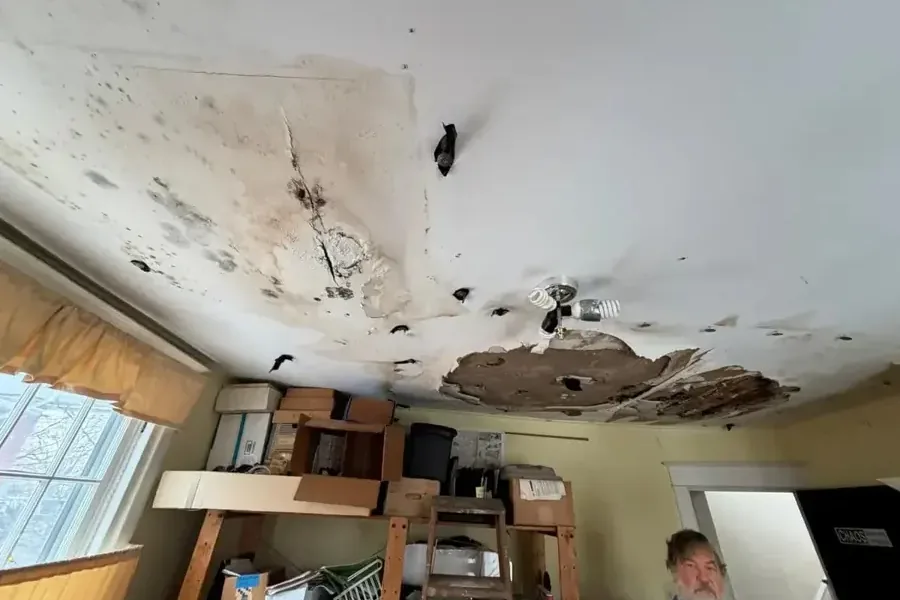
Calabasas sits in the foothills of the Santa Monica and Santa Susana mountains and has mild, relatively wet winters. Average yearly rainfall is 17.77 inches, and February is the wettest month at 4.65 inches. This post follows a roof leak from the first drip to the ceiling stain and explains how a tenant, an owner and the restoration team each fit in.
Key takeaways
- The wet months bring most of the rain, with February the wettest at 4.65 inches, so roof leaks tend to appear in winter.
- Roof water travels: it drops into attic insulation, runs along framing and shows up as a stain far from the opening.
- Hard cold snaps are uncommon here, so winter roof leaks come from rain, not ice.
- With 29.8% of occupied homes rented, a roof leak often involves a tenant and an owner who each need a record of the damage.
- Drying the attic and the ceiling comes before the paint goes on, since trapped moisture stains through fresh paint.
A mild climate with a wet season
The area has a hot-summer Mediterranean climate, with mild winters and hot, dry summers. That means a roof can go many months without a test, then face several wet weeks.
Cold snaps are uncommon in the area, with a mean January daily low of 46 F, so ice is rarely the cause of a winter roof problem.
What the rain numbers say
Average yearly rainfall is 17.77 inches, and February is the wettest month at 4.65 inches. A few strong storms deliver much of it.
Storm days
A heavy Southern California storm on February 2, 2019 brought more than 1 inch of rain per hour at its peak and a flash flood warning. It is a regional reminder of how fast a dry roof can turn into a leaking one.
Where roof water travels
A roof leak rarely stays under the opening. Water follows gravity and then the easiest route.
The distance between the opening and the stain is why a ceiling stain alone does not show where the roof failed. A roofer checks the area above and uphill of the stain.
Into the attic
Rain finds a gap in tile, flashing or a seam and drops into the insulation. Insulation holds the water like a sponge.
Along the framing and down the wall
Water runs along rafters and ceiling joists, sometimes a long way, then drops into a wall cavity or onto a ceiling.
Across the ceiling
A stain shows where the water finally soaks the drywall, which may be a room away from the roof opening.
Signs of a roof leak after rain
The timing is the clue. A roof leak shows up during or soon after rain, not during dry weeks.
Dry weeks make leaks easy to forget, so notes help. A dated photograph of each stain shows whether it is growing with each storm.
- A stain or ring on the ceiling that grows after rain.
- A drip, a bubble or sagging drywall during a storm.
- Damp insulation or dark framing when the attic is safe to reach.
- Peeling paint or a musty smell at the top of a wall.
- Water around a light fixture or a vent in the ceiling.
- A damp smell in a closet or hallway that gets worse after a storm.
First steps during a storm
Safety comes first, and a few actions limit the spread.
If the weather allows, a roofer can place a temporary cover until a full repair. Nobody should climb a wet roof to look.
- Place a bucket under the drip and move furniture and rugs aside.
- Stay out from under a bulging ceiling, since it can drop water and drywall at once.
- Switch off power to a room where water reaches a light fixture or outlet.
- Photograph the stain and any visible leak points.
- Contact the owner or property manager at once if the home is rented.
Tenant, owner and the repair order
With 29.8% of occupied homes in Calabasas rented, a leak often has two sides. The tenant lives with the damage and the owner holds the roof.
Responsibility depends on the lease and local rules, so a clear record helps both sides.
The restoration record also helps when a roofer, a landlord and an insurer have to agree on the sequence of the work.
- The tenant reports the leak in writing and keeps photographs with dates.
- The owner or manager arranges the roof repair.
- The restoration team documents the wet areas, removes soaked materials and dries the structure.
Drying first, then the repair
A roof repair stops new water, but it does not dry what is already wet. Roof leak water damage work covers the attic and the framing, while ceiling leak water damage work covers the room below.
Moisture readings set the timing for when the ceiling can be closed and painted. For the full list of services, see the local water damage restoration page.
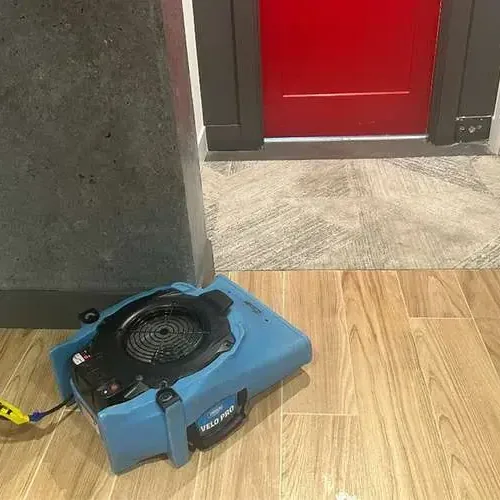
In the attic, wet insulation is removed from the wet area and the framing is dried with air movers and a dehumidifier before new insulation goes in. In the room below, the ceiling is opened only as far as the readings require.
What the repair scope depends on
Two roof leaks can look the same from the room and carry very different scopes. A few factors decide which one a home has.
- How long the water ran before it was noticed.
- Whether the attic insulation is soaked and needs to be removed.
- How far the water traveled along the framing.
- Whether the drywall stayed firm or went soft.
- Whether light fixtures or wiring sit in the wet area.
Questions
How much rain does Calabasas get in a year?
Average yearly rainfall is 17.77 inches, and February is the wettest month at 4.65 inches.
Do roof leaks happen in a mild climate?
Yes. A roof that goes months without rain can fail at a seam or a flashing during the first wet weeks, and mild weather does not stop that. A short dry spell followed by a hard rain is a common time for old leaks to reappear.
Who is responsible for a roof leak in a rented home?
It depends on the lease and local rules. The tenant should report the leak in writing and keep photographs, and the owner usually arranges the roof repair.
Can a ceiling stain simply be painted over?
Not until the ceiling and the attic above it are dry. Trapped moisture stains through fresh paint and can soften the drywall. Stain blocking primer helps only after the moisture is gone.
How long does drying a leaked ceiling take?
Drying runs for days and ends when moisture readings reach the dry range, not on a fixed date.
Is a roof leak the same as a ceiling leak?
They share a symptom but not a cause. A roof leak comes from weather entering from above, while a ceiling leak can come from a bath, a supply pipe or an air conditioner inside the house.